
Contract management for companies selling to the government
Companies get into trouble with government contracting in two ways. They grow past the compliance structure they started with, usually about eighteen months after the first significant award, and discover that the informal arrangement that worked at ten contracts does not work at eighty. Or they enter the market from the commercial side, win something, and find that the award they were celebrating carries obligations nobody in the building has read.
Sivad works on both problems, and on the underlying one they share: the contracts function is treated as paperwork until the day it becomes the thing that decides whether the company can bill, ship, subcontract, or close.

Contract vehicles and what each one demands

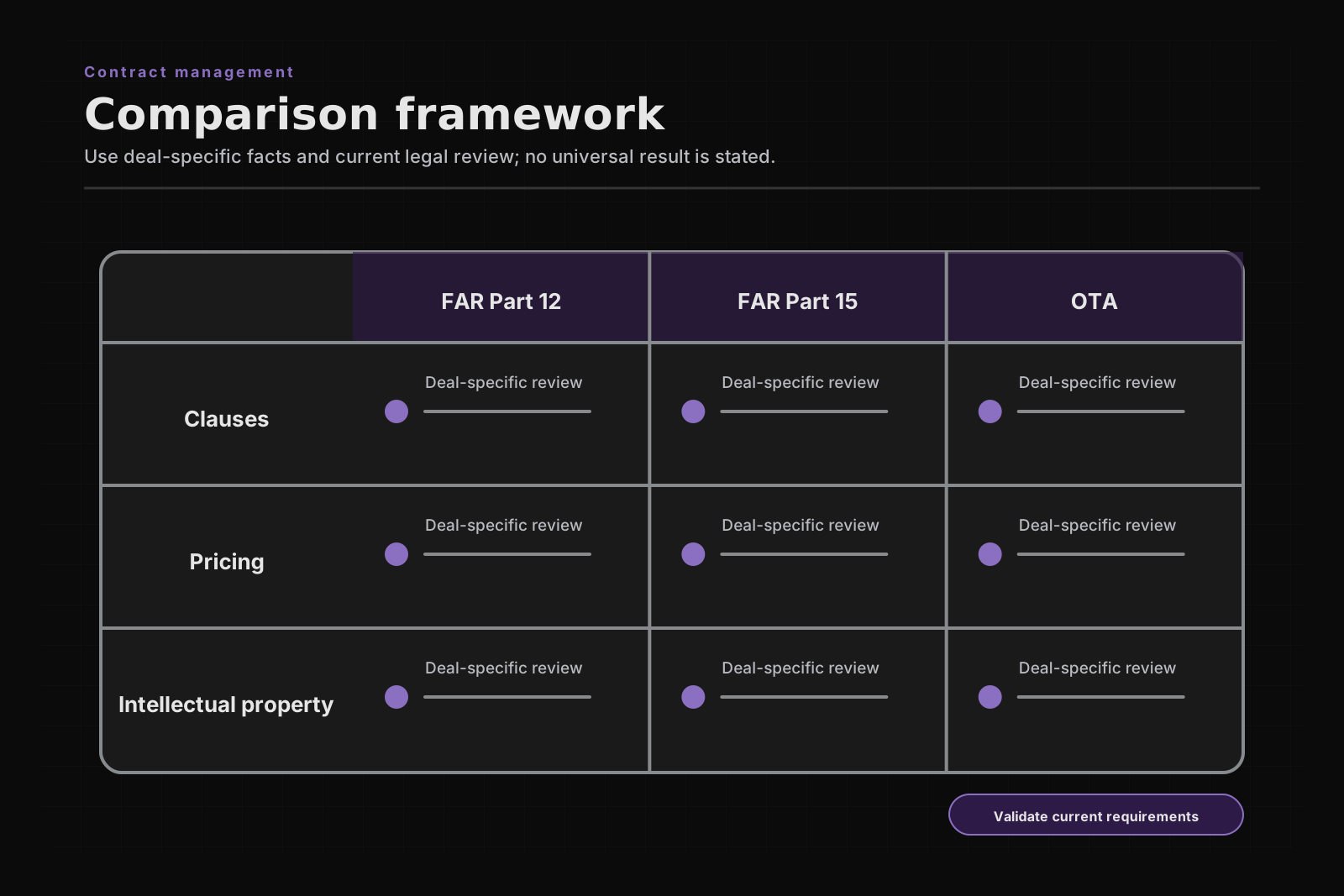
FAR Part 12 commercial buys
A commercial products or commercial services acquisition is the lightest regime available and it is frequently misused in both directions. Companies that qualify fail to pursue the determination and end up carrying cost accounting obligations they did not need. Companies that do not qualify assert commerciality on a product that has never been sold to the general public and are then unable to support the assertion when the contracting officer asks for the market research behind it.
The work here is getting the determination right and building the record that supports it, understanding which clauses actually apply under the standard commercial terms and the limited set of statutorily mandated flowdowns that accompany them, and establishing price reasonableness with data other than certified cost or pricing data. It also means recognizing the point at which a product’s federal-only variant has drifted far enough from the commercial baseline that the determination no longer holds.

FAR Part 15 negotiated procurements
A negotiated procurement puts the company’s cost structure on the table. Certified cost or pricing data may be required, the certification is a statement that the data is accurate, complete, and current as of the agreement on price, and the price reduction clause makes a careless submission a liability that outlives the contract. Around that sit forward pricing rates, provisional billing rates, cost realism, profit development, and a contract type that determines how risk is shared.
Sivad supports proposal development and pricing under this regime, prepares teams for fact-finding and negotiation, reviews the cost volume against the analysis the government will actually run on it, and builds the documentation practice that makes each negotiation defensible afterwards. The negotiation itself is covered in more depth on the negotiation training page, because the two problems are the same problem approached from different sides.

Other Transaction Agreements
Other Transaction Agreements are attractive because they sit outside the FAR, and that is also why they are risky for a company that treats them as a simpler contract. There are no default clauses protecting either party, which means the agreement contains exactly what was negotiated into it and nothing else. Intellectual property, data rights, termination, payment, and dispute resolution are all open, and a company accustomed to the FAR’s background protections can sign something that gives away a position it did not know it held.
Sivad works on prototype OT structuring and consortium participation, the nontraditional defense contractor and cost-share questions that determine eligibility, and the follow-on production pathway that is the reason most prototype agreements are worth pursuing in the first place. It also covers the practical mechanics of operating under a consortium vehicle, where the agreements officer, the consortium manager, and the government sponsor each control different parts of the outcome.
Flowdowns and subcontract compliance
Flowdown discipline is where most subcontract compliance failures originate, and they originate in one of two habits. Either the prime flows the entire prime contract clause list down verbatim, which imposes obligations on suppliers who cannot meet them and produces either refusals or false compliance, or the prime flows down a template that has not been refreshed since the last significant DFARS change and misses a mandatory clause entirely.
The obligations that matter most in practice are the ones with a system requirement behind them rather than a signature requirement. Safeguarding of covered defense information under DFARS 252.204-7012 carries the NIST SP 800-171 control set, the assessment and reporting obligations that go with it, and the incident reporting timeline. Counterfeit electronic part detection and avoidance imposes a system obligation and traceability to authorized sources. Specialty metals restrictions, domestic preference requirements, unique identification, and export control obligations each constrain sourcing before they constrain paperwork.
Sivad’s consultants review and rebuild flowdown matrices by clause and by supplier type, so that a commercial supplier receives the limited set that actually applies to a commercial subcontract and a cost-type development subcontractor receives the full set. The output is a matrix the buying team can apply without a lawyer on every purchase order, plus the training to use it.
Audits, reviews, and the systems behind them
CPSR readiness
A Contractor Purchasing System Review examines whether a company’s purchasing organization can be relied upon to spend government money without individual consent on every subcontract, and the ACO’s determination follows the FAR 44.302 criteria, with a review normally triggered once expected government sales pass the stated threshold. Approval is worth real operating freedom. A withdrawal of approval, or a finding of significant deficiencies in the purchasing system, restores consent requirements and can trigger payment withholding under the contractor business systems clause.
Readiness work follows the review’s own structure: written policies and procedures that describe what the organization actually does, a delegation of authority that is documented and observed, make-or-buy discipline, competition and source selection records, price and cost analysis that is performed rather than asserted, negotiation documentation, commercial item determinations, subcontract type selection, consent and notification compliance, flowdown accuracy, small business subcontracting plan administration and reporting, counterfeit parts and cybersecurity system requirements, purchase order file completeness, and an internal self-assessment program that finds problems before the review does.
The most common failure is not a missing policy. It is a purchase order file that cannot demonstrate why the price was reasonable, repeated across a sample.
DCMA and DCAA
The two agencies behave differently and preparing for one does not prepare a company for the other. DCMA administers the contract: delegations, property administration, government source inspection, progress payment and business system oversight, and the purchasing system review itself. Its questions tend to be about whether the company does what its procedures say it does. DCAA audits cost: forward pricing proposals, provisional and final indirect rates, incurred cost, accounting system adequacy, timekeeping and floor checks. Its questions tend to be about whether a cost is allowable, allocable, and reasonable, and whether the accounting system can prove it.
Sivad prepares organizations for both: walkthrough rehearsal, document package assembly, response discipline during the review, and the correction of findings afterwards in a way that closes them rather than deferring them. The preparation is also useful independent of any audit, because a company that can answer these questions quickly is a company whose own management reporting is trustworthy.
Incurred cost proposals
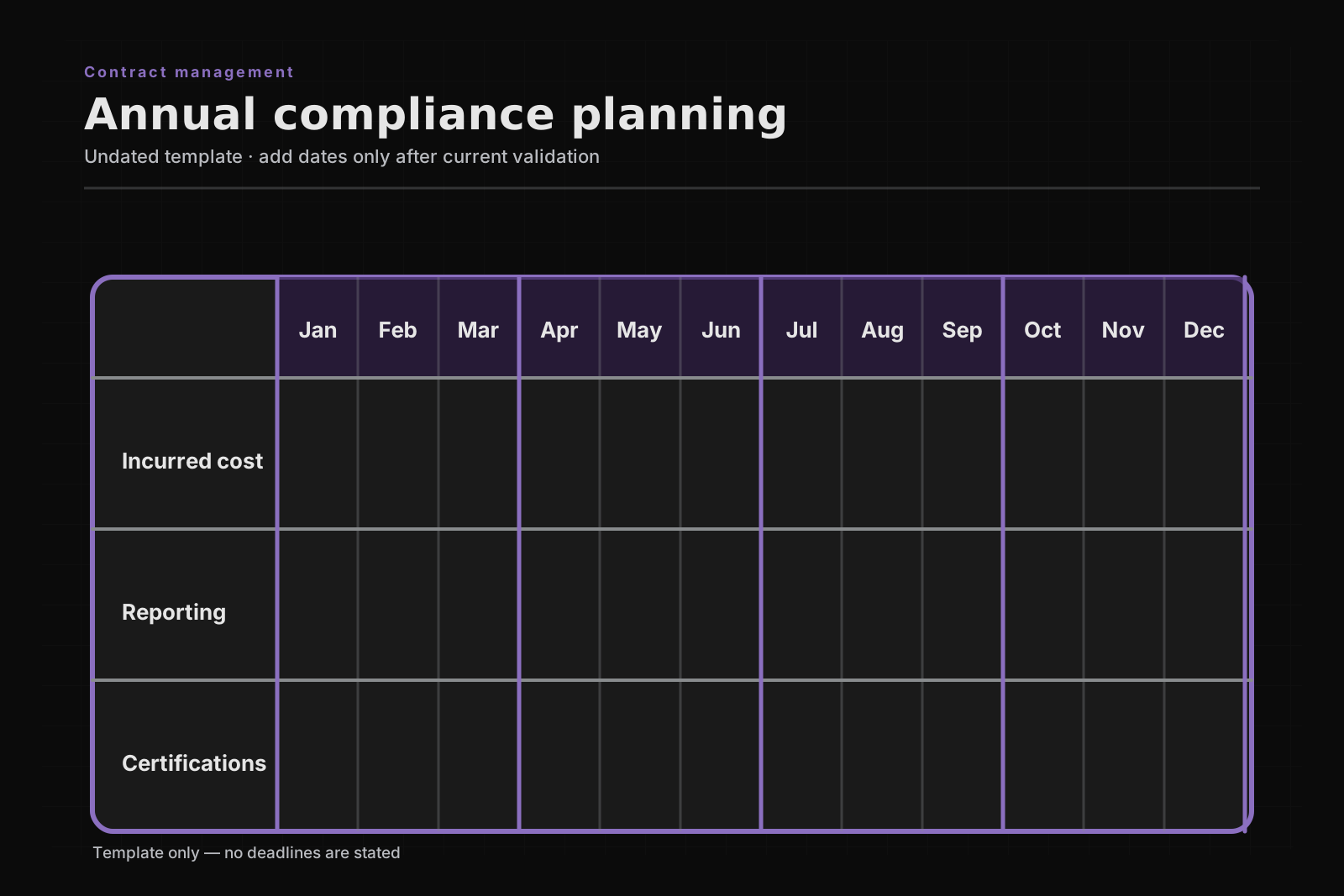
The annual incurred cost submission is due within six months of fiscal year end under the allowable cost and payment clause, and it is the mechanism by which final indirect rates get settled and contracts get closed. Late or inadequate submissions accumulate. A company several years behind on incurred cost proposals has unclosed contracts, unsettled rates, cash sitting in unbilled positions, and a due diligence problem waiting for it at the next financing or transaction.
The work covers building the submission to the adequacy standard, reconciling it to the books, handling expressly unallowable costs correctly given the penalty exposure attached to them, supporting the audit, and then instituting the year-end routine that keeps the company current instead of repeating the catch-up exercise annually.
Building a contracts function from scratch

A company that has won its way into the government market without a contracts organization usually has the work distributed across a founder, a finance lead, and outside counsel who is expensive and not in the room when decisions are made. That arrangement survives until the volume, the complexity, or the customer mix breaks it.
Contracts functions have been built from nothing before by the consultants who run this work, and the sequence below is drawn from that. Establish the operating model and the charter first, including where contracts sits relative to finance, legal, program management, and business development, because ambiguity there is the source of most subsequent friction. Define the lanes: prime government contracts, subcontracts and teaming, commercial and reseller agreements, international arrangements, and the high-volume low-risk instruments that should never reach a senior reviewer. Write the delegation of authority and get it approved by the board or the executive team, so signature authority is a documented control rather than a habit.
From there it is templates and fallback positions, a negotiation playbook that lets a junior person handle a routine agreement without escalation, intake and routing with review commitments people can rely on, contract lifecycle management tooling scaled to the actual volume rather than to the vendor’s demonstration, a compliance calendar, contract data and reporting that management will use, and a staffing plan with role definitions that tells the company who it needs to hire and in what order.
- Contracts operating model and charter
- Delegation of authority matrix, approved and published
- Contract lane definitions and routing rules
- Template library with fallback positions
- Negotiation and review playbook
- CLM tooling selection and deployment plan
- Compliance calendar and ownership
- Staffing plan with role definitions and hiring sequence
Where the method was proven
Sivad Enterprises has operated for 13 years and is family-operated. Sivad’s consulting work is in aerospace, defense, and the adjacent federal market.
Contract and supply chain organizations have been run across two decades of programs for NASA and the Department of Defense, with contract portfolios at major-program scale.
That record includes a procurement organization taken through a Contractor Purchasing System Review that closed with no findings and no observations, which is the reason the readiness work described above starts at the purchase order file and works outward instead of starting at the policy manual.
Find out what a review would find
A useful first conversation covers the contract portfolio, the clause exposure, the state of the purchasing files, and whether any submissions are overdue. That is normally enough to say whether the company is exposed, where, and what the sequence of work should be.