
Negotiation training for aerospace and defense
Most negotiation training teaches a general method and assumes the participant will fit it to their industry. That works in a market where price is the main variable and both sides are free to agree to whatever they want. It does not work well in aerospace and defense, where the contract type is often decided before anyone sits down, where a third of the terms in the agreement were written by the government and cannot be traded, and where the number on the quote is the output of a rate structure that the other side may be willing to explain if anyone thinks to ask.
This program teaches the negotiation that actually happens in this market. It is built on where price comes from, who is authorized to change it, which parts of an agreement are genuinely negotiable, and how the conversation changes once certified cost or pricing data is on the table.
The method is set out below, followed by the ten-module outline and a walkthrough of how a team engagement actually runs.

What conversational negotiation means
Conversational negotiation is Sivad’s term for running a negotiation as a structured exchange of information rather than a sequence of positions. It rests on a straightforward observation: the price a supplier or a customer opens with is almost never a decision, it is a calculation, and the assumptions inside that calculation are usually more negotiable than the total sitting on top of them. A position hides those assumptions. A question surfaces them.
In practice this means the early part of the negotiation is spent getting the other side to explain their own number, in their own words, in enough detail that both sides are looking at the same cost structure. What are the direct labor hours, and against which rate category. What is in material and what is in subcontract content. Which line carries schedule risk, and what specifically would have to change for that risk to come down. Where is the escalation assumption, and against what index. A supplier who has walked you through their build-up has told you where the money is, and has also, without intending to, told you which concessions are cheap for them and which ones are not.
It is worth being precise about what this is not. It is not rapport-building, and it is not the belief that a pleasant conversation produces a better deal. It is not splitting the difference, which is what a negotiation defaults to when neither side has done the analysis. It is not a substitute for preparation. Conversational negotiation is more demanding than positional bargaining, not less, because you cannot ask a useful question about someone’s cost structure unless you already understand cost structures, and you cannot trade a term intelligently unless you have priced what that term is worth to both sides before you walk in.
The reason it works in this market specifically is that defense negotiations are repeated games between parties who will see each other again on the next program, frequently under a contract type nobody at the table selected. Positional bargaining in a repeated game with a constrained solution space produces small wins and lasting damage. Structured information exchange produces agreements that survive the first schedule change.
The mechanics
Reading the counterparty's cost stack
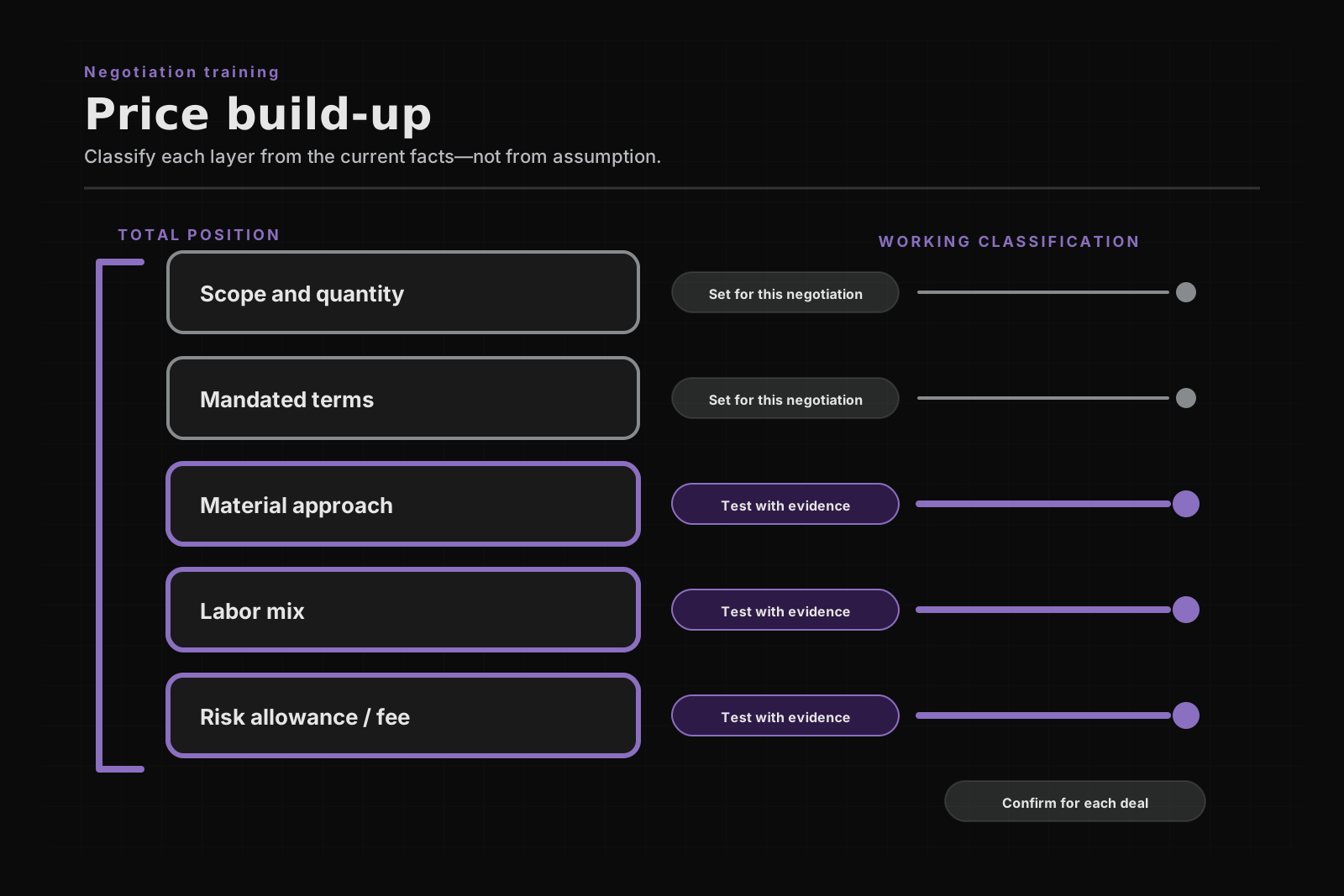
Every price in this industry decomposes the same way: direct labor hours by category multiplied by a labor rate, plus fringe, plus overhead, plus material, plus material handling or subcontract burden, plus general and administrative expense, plus facilities capital cost of money where it applies, plus fee. Participants learn to rebuild that stack from the outside using what is observable, and to recognize which layers move and which do not. A supplier’s forward pricing rates are largely fixed in the near term and arguing about them is usually wasted effort. Direct hours, material content, make-or-buy decisions, escalation assumptions, and the risk contingency buried in a bid are where the movement actually is.
The same discipline runs in reverse on the sell side. A seller who understands how their own price will be analyzed can build a proposal that survives the analysis instead of one that invites a hostile fact-finding round.
Anchoring on structure rather than price
The first number said out loud sets the frame, which is why so much conventional training is about who anchors and at what. That advice is close to useless when the price is a calculation and both sides know it. The stronger anchor in this market is structural: the term of the agreement, the quantity commitment, the option structure, the escalation index, the payment profile, the delivery schedule, the inspection point, the warranty period, the liability position.
Anchor on a five-year agreement with firm pricing and a volume commitment and the price discussion happens inside a frame you built. Anchor on a unit price and you have handed the other side the only variable that matters and told them nothing else is on the table. Participants practice opening on structure, and practice recognizing when a counterparty is doing it to them.
Trading terms rather than conceding on price
The program’s central working tool is a trade list: a written inventory, built before the negotiation, of everything either side could give, each item scored on what it costs the giver and what it is worth to the receiver. Most negotiations are lost on the items where those two numbers diverge sharply and nobody noticed. Payment timing is frequently expensive for one side and nearly free for the other. So are forecast visibility, order aggregation, delivery flexibility of a few weeks, source versus destination inspection, tooling ownership, minimum order quantities, and the length of the warranty tail.
Participants build a trade list against a real file of their own during the program. The instruction is blunt about the failure mode: teams that arrive with only price on the list will negotiate only price, and will lose the items they never priced.
Approval thresholds and who can actually say yes
A concession that the person across the table cannot approve is not a concession, it is a delay. Participants learn to map the counterparty’s delegation of authority before the negotiation: what the individual can sign, what goes to a manager, what triggers a deal desk or a contract review board, what requires a pricing committee, and what evidence each of those levels needs in order to approve. Discount authority in most organizations is banded, and the bands are knowable.
The practical consequence is sequencing. Asks that sit inside the room’s authority get resolved in the room. Asks that require escalation get raised early, in writing, with the justification the approver will need, because an escalated ask introduced in the final session is an ask that gets denied on schedule grounds. On the government side the same logic applies to consent to subcontract and to the internal justification a buyer must document when competition is limited.
Sole-source dynamics
Single-source and sole-source positions are the normal condition for qualified flight hardware, and most buyers behave as though they have no leverage in them. Some of that is correct and the program says so. Qualification is expensive, the alternate source may not exist, and threatening to walk from a sole source is a bluff a competent supplier will call.
What remains is real and is mostly not price. Term and volume commitment convert an uncertain revenue stream into a forecastable one, which is worth genuine money to a supplier’s own planning. Payment timing is worth money to a supplier carrying inventory. Demand aggregation across programs or business units changes the supplier’s production economics. Requirements flexibility, where engineering is willing to accept an existing part rather than a bespoke one, changes the negotiation completely. Funding a second source, or funding a qualification path even without exercising it, changes the supplier’s assessment of the future. And there is a durable, underrated form of leverage in being an easy customer: clean purchase orders, stable forecasts, prompt payment, and technical questions answered the same day are worth a discount that most suppliers will grant to keep.
Participants also learn the sole-source negotiation the other way round, because the same team is frequently the sole source on someone else’s program.
Long-lead components and the calendar
In this market the negotiation is often about the calendar rather than the price. Castings and forgings are bought as production slots. Raw material is bought as mill heat lots with minimum quantities and their own qualification trail. Space-grade electronic parts carry screening and lot acceptance schedules that do not compress for anybody, and obsolescence forces last-time buys with cash consequences that fall outside the program budget.
The teachable point is that time is a tradable currency and most buyers spend it accidentally. A commitment made early is worth more to a supplier than a larger commitment made late, and the buyer who understands the supplier’s own production planning cycle can buy schedule at a discount. Participants learn to identify the long-lead items on their own bill of material, price the schedule risk attached to each, and negotiate the slot before negotiating the part.
What a prime can and cannot concede
A great deal of subcontract negotiation is spent asking a prime for things the prime has no authority to give, which wastes the negotiation’s credibility on items that were never available. Mandatory flowdowns are the clearest case: the socioeconomic clauses, safeguarding of covered defense information under DFARS 252.204-7012 and the NIST SP 800-171 obligations behind it, specialty metals restrictions, counterfeit electronic part detection requirements, and unique identification requirements are pushed down because the prime’s own contract requires it. A prime that agreed to drop them would be creating a compliance finding for itself.
The negotiable set is larger than most subcontractors assume, and it is where the asks should be spent: payment terms and milestone structure, the treatment of long-lead material and inventory, forecast and quantity commitments, escalation, warranty duration and remedy, liability caps and consequential damages, delivery and inspection points, termination for convenience settlement mechanics, and the boundary between background and foreground intellectual property for privately funded development. Participants learn to sort a proposed subcontract into the two categories in a single pass, and to open the negotiation having already conceded the items that were never in play, which buys standing on the items that are.
How FAR Part 15 changes the conversation
A negotiated procurement under FAR Part 15 is a different exercise from a commercial buy under FAR Part 12, and the difference is not procedural formality. Once certified cost or pricing data is required, the supplier’s cost structure stops being something you have to infer and becomes something they are obligated to submit and certify as accurate, complete, and current as of the date of agreement on price. The negotiation shifts from persuasion to analysis.
The program covers the mechanics that decide which conversation you are in. When certified cost or pricing data is required and when an exception applies, including adequate price competition, commercial products and commercial services, and prices set by law or regulation. What data other than certified cost or pricing data is, when it is the right ask, and why requesting it badly produces a fight that a precise request would have avoided. How price analysis and cost analysis differ, and which one a buyer is entitled to perform in a given situation. How profit is developed on the government side, including the weighted guidelines approach, so that a supplier stops treating fee as a negotiating whim and starts treating it as a defensible output. What defective pricing exposure means for a supplier who submits a certificate carelessly, and why the price reduction clause makes sloppy cost submissions a long-term liability rather than a short-term win.
Contract type gets the same treatment, because the type frequently determines the negotiation before anyone opens their mouth. Firm fixed price, fixed price incentive with its share ratio and ceiling, cost plus fixed fee, cost plus incentive fee, and time and materials each reward completely different negotiating behavior, and the point of total assumption on a fixed price incentive arrangement is a number that most people at the table have never calculated for the deal in front of them.
Participants finish this module able to tell, from the solicitation and the clause list, which regime they are operating under, what the other side is obligated to give them, and what they are obligated to give in return.
Building the rate structure and the price justification in the first place is separate work, and Sivad is engaged for it directly. That is described on the government pricing page.
Training outline
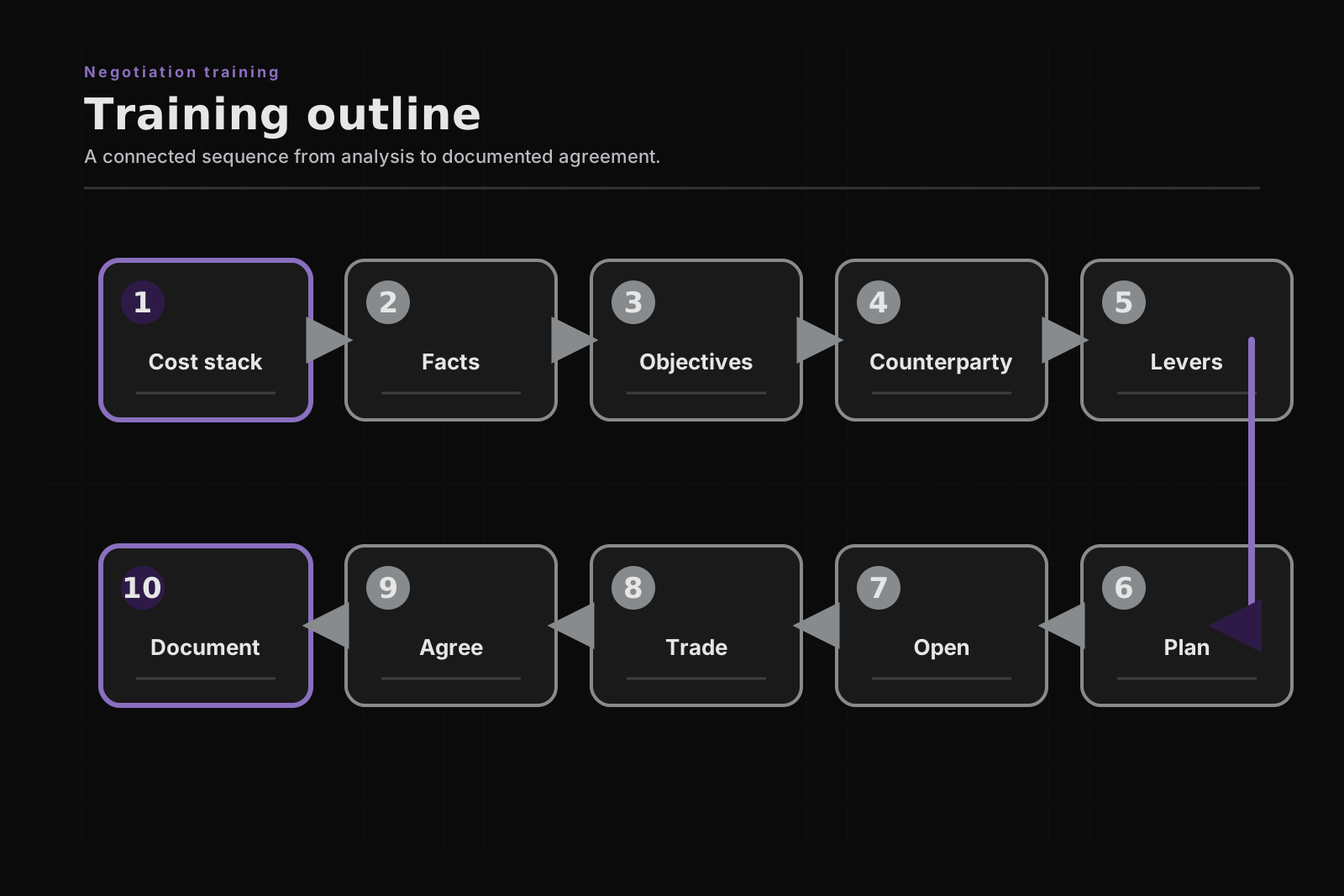
The full program is ten modules. The multi-session format runs one module per session, with work applied to the participant’s own live files between sessions. The one-day workshop compresses modules 1 through 4 plus the practicum.
| Module | What it covers | What participants leave with |
|---|---|---|
| 1. Where the price came from | Anatomy of a price build-up: direct hours and rate categories, fringe, overhead, material and handling, subcontract content, G&A, cost of money, escalation, fee. Which layers move and which do not. | A reconstructed cost stack for a real quote from their own file |
| 2. Who can actually say yes | Mapping the counterparty’s delegation of authority, discount bands, deal desk and review board triggers, and the evidence each approval level requires. Sequencing asks against that map. | An authority map for their current counterparty, and a revised ask sequence |
| 3. Anchoring on structure | Opening on term, quantity, options, escalation index, payment profile, delivery, inspection point, warranty, and liability instead of on unit price. Recognizing and resetting a price-first frame. | A structural opening position for a live negotiation |
| 4. The trade list | Building a written currency table before the negotiation: every possible concession scored on cost to give and value to receive. Identifying the asymmetric trades. | A completed trade list for a live file, reviewed in session |
| 5. Sole source, and the leverage that remains | Honest assessment of what leverage does and does not exist in single and sole-source positions. Term, volume, payment timing, demand aggregation, requirements flexibility, qualification funding, and the value of being an easy customer. | A sole-source strategy for one supplier, including what will not be attempted and why |
| 6. Long-lead components and the calendar | Production slots, mill heat lots, screening and lot acceptance schedules, obsolescence and last-time buys. Buying the slot before buying the part. Pricing schedule risk. | A long-lead map of their own bill of material with schedule risk priced |
| 7. What a prime can and cannot concede | Sorting an agreement into mandatory flowdowns and the genuinely negotiable set. DFARS obligations the prime does not own. Where to spend asks. | A two-column sort of a real proposed subcontract or purchase order |
| 8. FAR Part 15 and cost and pricing data | Certified cost or pricing data and its exceptions, data other than certified, price analysis versus cost analysis, profit development and weighted guidelines, defective pricing exposure, and contract type selection including the point of total assumption. | A written assessment of which pricing regime governs their current pursuit |
| 9. Practicum | Live simulated negotiations against a case built from the cohort’s own market, run in rounds, recorded where the organization permits it, with structured debrief after each round. | Recorded rounds and a written self-assessment against the method |
| 10. Documentation and handover | Building the negotiation record: what was agreed, what analysis supported it, what was traded and why. Price negotiation memoranda, file documentation that survives an audit, and internal facilitator enablement. | A documented negotiation file and, for internal facilitators, the material to run modules 1 through 4 again |
What the first session looks like, and what the sixth looks like
Session one is diagnostic and uncomfortable by design. Participants bring a live file, and the session is spent taking apart a price they have already accepted or are about to accept, in front of their peers. Most cohorts discover in the first ninety minutes that nobody in the room can explain where a number came from, which is the point.
By session six the same participants are running a negotiation in front of the group, being interrupted, and defending their trade list under pressure. The visible change is not confidence, which arrives early and means little. It is that the questions have become specific: they ask about the rate category rather than the total, about the approval band rather than the answer, about the slot rather than the part.
What an engagement looks like
The walkthrough below is representative rather than a description of a particular client. It sets out how a team engagement is structured, what is asked for, what happens in the room, and what the organization is left with, using a composite situation drawn from how this work is actually delivered. Sivad’s documented client engagements are published separately at /work/, and none of them is described here.
What brings a team in
Engagements vary, but a typical team engagement runs like this. A director of supply chain has four negotiations landing inside the same two quarters: a long-term agreement expiring, a sole-source supplier that has sent a price increase letter with a short response window, a new prime relationship whose subcontract terms nobody on the team has read closely, and a re-quote on a part that went obsolete.
The team is eight people, competent and busy, and the problem is not effort. They are negotiating price after everything else has already been decided, and nobody in the room can explain how the supplier arrived at the number they are arguing about.
Intake, and what we ask for
Intake is a call and a document request with the consultants who would run the program, both under a mutual nondisclosure agreement signed before anything moves. We ask for the last three negotiations the team completed: the quote or proposal, any price build-up the supplier provided, the resulting purchase order or subcontract, and the correspondence around it.
We also ask for the supplier list ranked by spend, the delegation of authority in whatever form it exists, the standard terms and flowdown package, and a calendar of what is coming in the next two quarters. Clients redact what they need to redact, and a redacted file is still usable, because the method works on structure rather than on identity.
The material is the client's own file
Textbook cases do not survive contact with this audience. Teaching material is built from the client’s live and recently closed negotiations, so that a participant works the modules against the supplier they will be sitting across from next month rather than against a case written for a business school.
Where a file is too sensitive to bring in front of the whole cohort, we build a parallel case with the same structure and different identifiers. What is never done is substituting a generic commercial scenario, because the first thing a skeptical participant does with a generic scenario is dismiss it, and they are right to.
Session structure and cadence
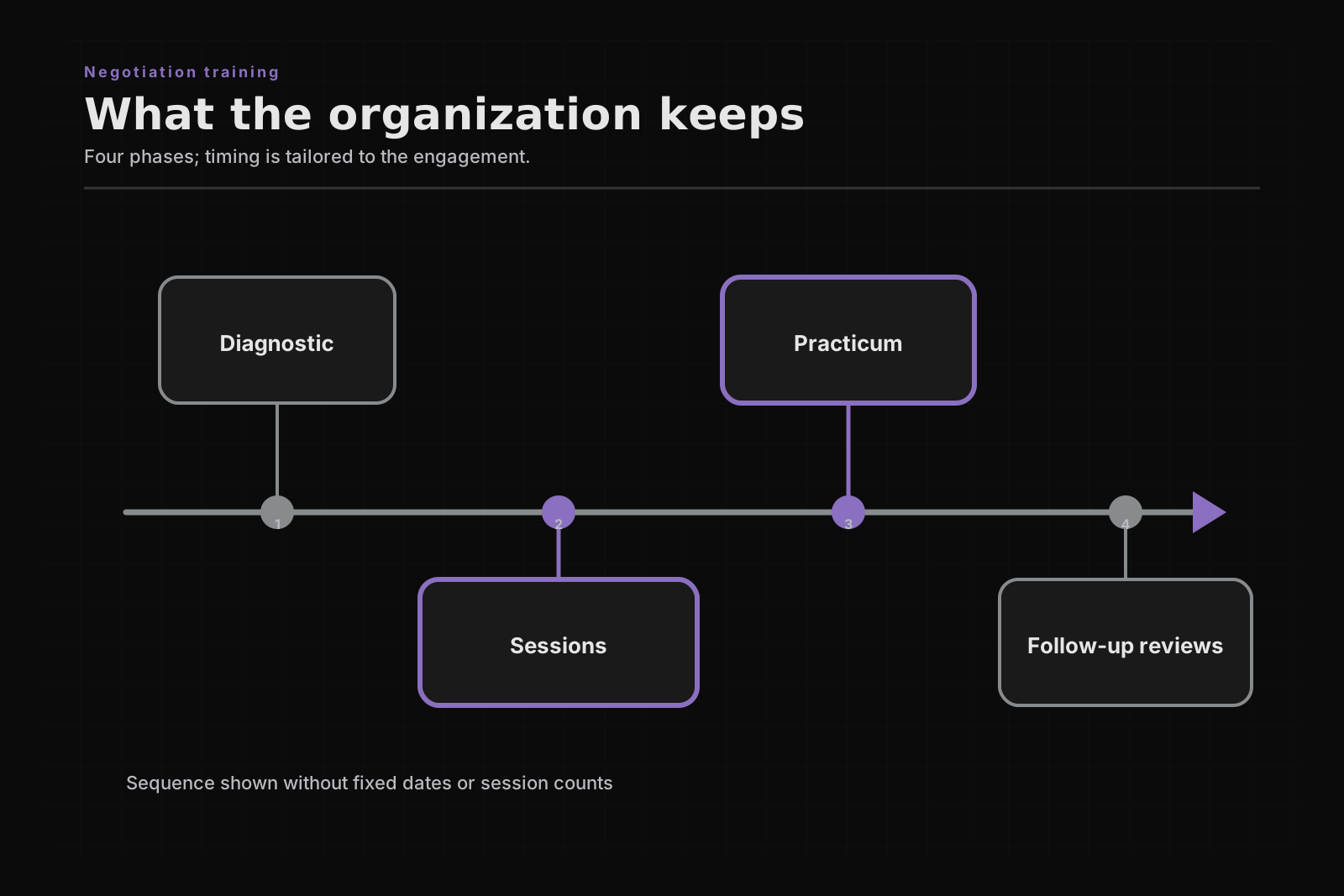
A half-day diagnostic opens the engagement, and it is deliberately uncomfortable: the room takes apart a price the organization has already paid. Sessions are built to run one module at a time, with work applied to a live file in between.
Each session is roughly a third instruction, a third work on the participants’ own files, and a third practice under pressure. The between-session work is not optional and it is not written exercises; it is the participant’s actual preparation for an actual negotiation, brought back and reviewed in front of the group.
The practicum and counterparty simulation
Participants practice in rounds. The facilitator plays the counterparty, briefed from the real quote and the real rate structure, holding a written reservation position and an approval band the participant cannot see, and behaving the way that counterparty actually behaves.
Rounds are timed. A round can be stopped mid-sentence, rewound to the moment a concession was given away for nothing, and run again from there. The rest of the cohort observes against a written scoring sheet rather than simply watching, and every round ends in a structured debrief against the method rather than against the outcome. Rounds are recorded where the organization permits it. The same case is run a second time late in the program, which is how the change becomes visible to the participant rather than only to the facilitator.
What managers get, separately
Managers attend their own session, because the failure mode they own is a different one. They work on setting the objective and the walk-away before the team goes in, reviewing a trade list without rewriting it, holding position when a supplier escalates over the team’s head, and writing a delegation wide enough that a buyer can close something in the room.
They also receive the diagnostic findings in aggregate: what the team could and could not do in week one, described as a capability picture and never attributed to an individual. Nothing said by a participant in a session is reported upward by name, and participants are told that at the start.
The weeks after the classroom
The classroom portion sits in the middle of an engagement rather than at the end of it, because the method is only real once it shows up in the file, which is why the record at 30, 60, and 90 days is what the engagement is judged on rather than the sessions themselves.
What the organization keeps
At the end the organization keeps working documents rather than a binder. A trade list template populated with its own commodities, an authority map for its principal counterparties, cost stack worksheets built against its actual suppliers, and negotiation files documented in a form that survives an audit.
It also keeps the facilitator material for modules 1 through 4, so that the front of the program can be run in-house for new hires without buying it again. That is deliberate, because the front of the program is the part an organization should own rather than buy twice.
Who this is for, and who it is not for

Buyers and supply chain teams
Procurement, subcontracts, and supply chain professionals negotiating against qualified suppliers, single sources, and primes, usually with less authority than the person across the table.

Contracts and pricing professionals
Contracts managers and pricing analysts working negotiated procurements, commercial buys, and other transaction agreements, who need the cost analysis and the conversation to line up.

Sales and capture teams
Business development, capture, and sales professionals selling into primes and government customers, who are being cost-analyzed and should understand the analysis being run on them.
Where this is a poor fit
It is not a keynote and not a morale session before a large meeting. A workshop that never touches a live file does not change what a team does in a negotiation, and it is better to say that before an engagement than after one.
It does not work for an organization that cannot share real files, even under a nondisclosure agreement and even redacted. The material is the client’s own record, and there is no version of this that runs on invented data.
It is a poor fit for high-volume transactional or consumer sales negotiation. The method is built on cost structure, regulated contract types, approval hierarchies, and long qualification cycles, and very little of it transfers to a market without them.
It will not fix a problem that is actually about authority. Where buyers are routinely overruled by engineering, or a program manager concedes over their heads to protect a schedule, training the buyers changes nothing that matters, and the scoping call will say so rather than sell around it.
And if the real problem is that your own price cannot be evaluated by a contracting officer, the work you need is pricing rather than negotiation training. That is a different engagement, described on the government pricing page.
The team formats assume a group with a shared supplier base and a shared pipeline, and an individual carrying a single hard negotiation is usually better served elsewhere.
Where the documented work is
Sivad Enterprises has been engaged to deliver negotiation training. What is not on this page is a named client, a quotation, or a measured result, because none of those has been released for publication, and this site does not publish claims it cannot support.
The client engagements documented and published run from executive coaching that carried a senior technical contributor into a VP role, through government pricing strategy for a commercial technology company entering the federal market, proposal cost support for a space electronics supplier, and procurement optimization for a contract manufacturer carrying a much larger commercial contract, to regulatory training delivered to an aerospace machining supplier. They are described by situation rather than by name on the work page.
The closest published record of this negotiation method in use is the method note carried on the Work page, covering a subcontractor team restructured mid-program and a multi-phase negotiation in which every option had to be priced and defended independently.
Bring a live negotiation to the first call
The scoping call is more useful with a real file in front of it, so bring a negotiation that is currently open or recently closed, and the call will produce a concrete read on where the method would have changed the outcome, along with a recommendation on which delivery format fits the team.