
Building a price a contracting officer can award
A federal agency wants what you sell. That part is settled. What is not settled is how you turn a commercial price list into a submission a contracting officer can evaluate, document, and defend to somebody who was not in the room.
Sivad’s consultants build that structure. Labor categories with written qualification standards, rates that hold across every year of the period of performance, a justification that traces the total back to hours and units, and answers ready for the questions the evaluator is going to ask.

The position most companies are in
The product is good and somebody at the agency has already said so. There is an opportunity with a date on it. And there is no answer to the question the contracting officer is about to ask, which is not what does it cost but how do you know that is a fair and reasonable price.
A commercial price answers one question: what will this customer pay. A federal price has to answer four. What are you selling, expressed in categories the government recognizes. What does each unit cost, per year, for every year of the contract. On what basis is that fair and reasonable. And what happens to the price when the requirement moves, as it will.
The instinct at this point is to submit the commercial list price with a discount attached and a cover letter explaining the value. That reliably produces a set of evaluator questions the company cannot answer, and the questions arrive at the point in the schedule where there is no time left to build the thing that should have existed at submission.
Why a commercial price is not a federal price
The first decision is whether the offer runs under FAR Part 12 as a commercial product or service, or under FAR Part 15 as a negotiated procurement. Framed correctly at the start, a commercial determination lets the contracting officer support price reasonableness with market data, sales history, and competition, and spares a company an accounting exercise its systems were never built to survive. Framed carelessly, it invites a certified cost buildup from an organization that has no indirect rate structure to certify.
The second is contract type. Firm-fixed-price is what most agencies prefer and what most commercial companies assume they want, and it moves performance risk onto the seller in a way that has to be priced on purpose rather than absorbed by accident. A justification for a fixed price is not a paragraph asserting that the price is fair. It is an auditable line from categories and hours and units to the total, with every assumption written down, so that a change in requirement produces a priced change instead of an argument.
The third is that a rate card is a commitment. Rates proposed for the out-years bind the company for the out-years, and escalation left as a placeholder percentage is the first thing an evaluator circles. Categories written to flatter the org chart rather than to match the people who will actually charge the contract create an invoicing problem in month one, when the timecard and the rate card disagree in writing.
Where the method was proven
This work is written from the receiving end of the examination itself: a procurement organization run to this standard went through a Contractor Purchasing System Review — the government’s audit of whether a contractor’s own price and cost analysis can be relied upon — and the review closed with no findings and no observations. That is the standard the justification and benchmarking work described below is written to. The objective is not a price an evaluator will accept once. It is a file an evaluator cannot fault later.
What a typical engagement covers
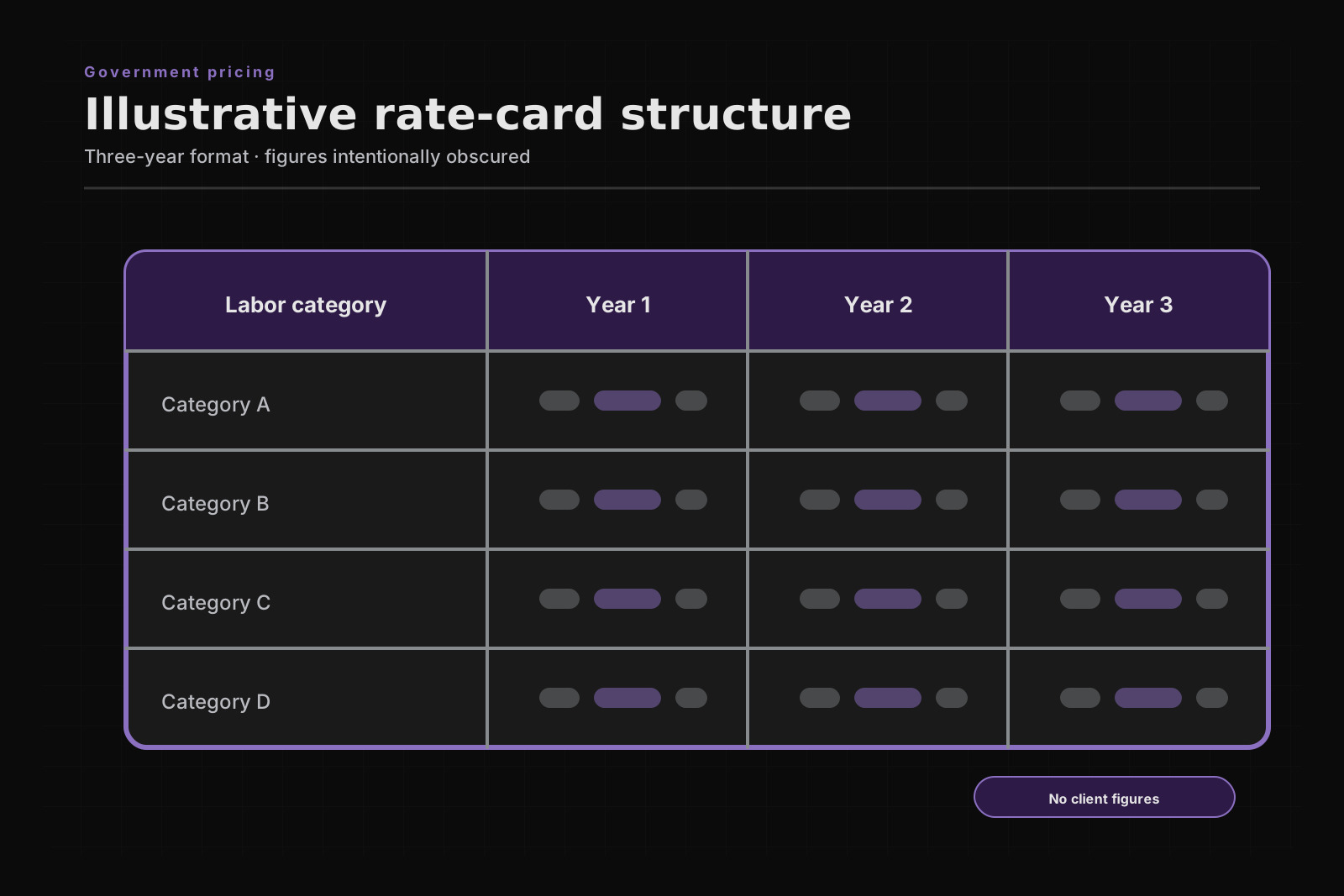
1. Labor category and rate card construction. Every labor category defined with a written qualification standard, with education and experience substitutions stated, and a fully burdened rate built for each year of the period of performance. Escalation is negotiated once, at the front, with a stated basis behind it. Categories are written against the people who will actually charge the contract, because a rate card that does not survive contact with the timecard is a billing dispute waiting for month one.
2. Firm-fixed-price justification. A worked buildup tying the proposed price to categories, hours, units, and assumptions, revised as the requirement and the company’s own position firm up. The document exists to give the contracting officer the material to write a determination of price reasonableness. Written well, it is most of that determination already drafted.
3. Competitive rate benchmarking. Proposed rates positioned against comparable published and awarded rates for equivalent categories, so the company sees where each one sits in the band before the government does. Benchmarking is a pricing decision tool first and an evaluation defense second. A rate that cannot be explained relative to the market gets challenged whether it is high or low.
4. Cost volume support. The estimate structured against the work breakdown, each element carrying a stated method and the evidence behind it, and the cost volume built against the technical volume rather than after it. Evaluators read the volumes against each other, and a plan that commits to staffing the estimate does not carry is read as either an error or an attempt.
5. Responses to government pricing questions. Direct written answers to what the agency raises on the pricing volume during evaluation, carried through as many revisions as the exchange takes. This is the part nobody plans for and it decides more awards than the initial submission does, because the question set tells you precisely what the evaluator is uncomfortable with.
6. Pricing strategy for a first federal sale. For a company that has never sold to a government buyer, the work starts before the workbook: which vehicle, which contract type, what the commercial determination should be, what the accounting system can and cannot support, and what has to be true internally before a price can be committed for three years.
What you walk away with
 A rate card you own. Categories, qualification standards, and burdened rates for every year of the period of performance, in a workbook your finance team can maintain and reuse without calling us.
 A justification that stands on its own. The price buildup and the assumption set written so that a reviewer who was not in the room can reconstruct the number.
 A benchmarking file. Where your rates sit against the market, by category, so the next pricing decision starts from evidence rather than from instinct.
A question-and-answer record. What the government asked, what was answered, and what it commits you to, which is the document your next pursuit team will be glad exists.
These are working documents rather than consulting artifacts. A rate card built across a multi-year period of performance is an asset for the life of that period, and the second federal pursuit starts from a structure that already exists rather than from a blank page.
How the work runs
Engagements of this kind are scoped as defined pieces of work with an end point rather than as standing arrangements, run against the agency’s schedule, and tracked from inception to submission against a single reference. The pricing volume is usually the last thing finished and the first thing questioned, so the work concentrates around the estimate, the internal review gates, and the evaluation exchange.
Where this has been done
Pricing a commercial product for a federal buyer. A commercial technology company with a product a federal buyer had already decided it wanted, and no rate structure a contracting officer could evaluate. Multi-year labor category rate card, firm-fixed-price justification, competitive benchmarking, and the responses to the government’s pricing questions.
Cost support inside a live bid cycle. A space electronics supplier working a program proposal and a subcontract to a large defense prime at the same time, short on cost volume capacity inside the bid window.
Neither client is named. Confidentiality agreements cover this work, and the sensible default in government contracting is to describe an engagement by its situation rather than by its logo. Where a client gives written permission to be named, we will name them, and the page will say so.
Who this is for
Companies with a product or service a federal customer wants and no price structure to sell it with. Commercial technology companies making a first federal pursuit. Suppliers moving from prime subcontracts to direct government sales. Companies that have submitted once, received a question set they could not answer, and want the structure built properly before the next attempt.
Who this is not for
Companies looking for someone to lower a price without changing what sits behind it. Organizations that want a compliance opinion rather than a pricing structure, which is work for counsel. Pursuits where the submission is due in days and the underlying cost data does not exist, where the honest answer in a scoping call is that the remaining time is not enough.
If you have a federal opportunity and no price structure
The first conversation is a working session rather than a pitch, so bring the solicitation or the agency conversation you are in, what you sell commercially, and how your costs are actually structured, and we will tell you what has to exist before you can submit and whether the time remaining is enough to build it.