
Supply chain consulting for flight-qualified hardware
Supply chain work in a regulated environment is a different discipline from supply chain work in general industry, and the difference is not paperwork. A part that fails inspection on a commercial line is a delivery problem. A part that fails inspection on flight hardware is a qualification problem, a configuration problem, a nonconformance record, and frequently a customer notification, and it arrives with a lead time that cannot be recovered by expediting because the constraint is a furnace slot or a screening cycle rather than a truck.
Sivad’s consultants work on the parts of this system that are actually controllable: how the supplier base is structured, how material is committed, how requirements reach suppliers, and how nonconformance and delivery performance are measured and acted on.

Where the work usually starts

Replacing commodity buying with negotiated long-term agreements
The most common structural problem in this market is an organization buying flight hardware transactionally: a requisition raised when the demand appears, three quotes, a purchase order, and a lead time set by whatever the supplier’s queue looks like that week. On complex qualified hardware that pattern produces lead times measured in years, because every order re-enters the queue at the back, re-triggers first article and qualification questions, and gives the supplier no reason to hold material or reserve capacity.
The alternative is to commit. Multi-year agreements with firm pricing, volume commitments, reserved capacity, and material held against a forecast change the supplier’s planning problem completely, and they change the buyer’s cost position because a supplier pricing a known multi-year stream prices differently from one pricing a surprise. Lead times on flight-qualified hardware have come down from years to months on exactly that shift: commodity-based fulfillment converted into negotiated long-term contracts, production slots and material positions bought rather than parts, and the whole term priced rather than the next order.
The work involves segmenting the bill of material by lead time and criticality rather than by spend, identifying which items justify a long-term agreement and which genuinely do not, structuring the agreements so they survive a program rate change, and negotiating them. The negotiation itself draws on the same method taught in the negotiation program.

Rationalizing the supplier base
Supplier bases grow by accretion. A part gets sourced, a program adds a source, an acquisition brings its own, and within a few years the organization is carrying hundreds of active suppliers, a long tail of which produce a handful of purchase orders a year each and consume a disproportionate share of the buying team’s hours, audits, quality oversight, and compliance obligations.
Rationalization is not simply cutting the tail. It is deciding, item by item, where consolidation buys real leverage and where a second source is worth its qualification cost as insurance. That work has been done at a scale of hundreds of suppliers, and the recurring finding at that scale is that the tail is not the expensive part. The expensive part is a mid-tier of suppliers who are large enough to matter and small enough to be unmanaged.
The output is a segmented supplier base with a stated strategy per segment, a defensible plan for where dual sourcing is funded and where it is not, and a workload model that tells the organization how many suppliers its buying team can actually manage properly.

Nonconformance and on-time delivery
Nonconformance rates and on-time delivery are the two numbers a program office asks about, and both are usually treated as quality department problems when they are procurement problems in most of their root causes. Requirements reach the supplier incomplete or ambiguous. Drawings and models are released without the notes the supplier needed. Purchase orders carry the wrong revision. Special process requirements are flowed inconsistently. First article expectations are not agreed before the part is cut. Delivery dates in the system are dates nobody negotiated.
Nonconformance has come down substantially and on-time delivery has improved substantially on human spaceflight hardware by attacking the procurement-side causes: cleaning up requirement flowdown, fixing purchase order content and revision control, agreeing first article and source inspection expectations up front, and building supplier scorecards that measure what the supplier can actually control. The improvements held because they were built into the procedures rather than into a recovery campaign.
Engagements here start with a read of the last twelve months of nonconformance records and delivery misses, sorted by cause rather than by supplier, which almost always relocates the problem from where the organization believed it was.

Multi-tier raw material strategy
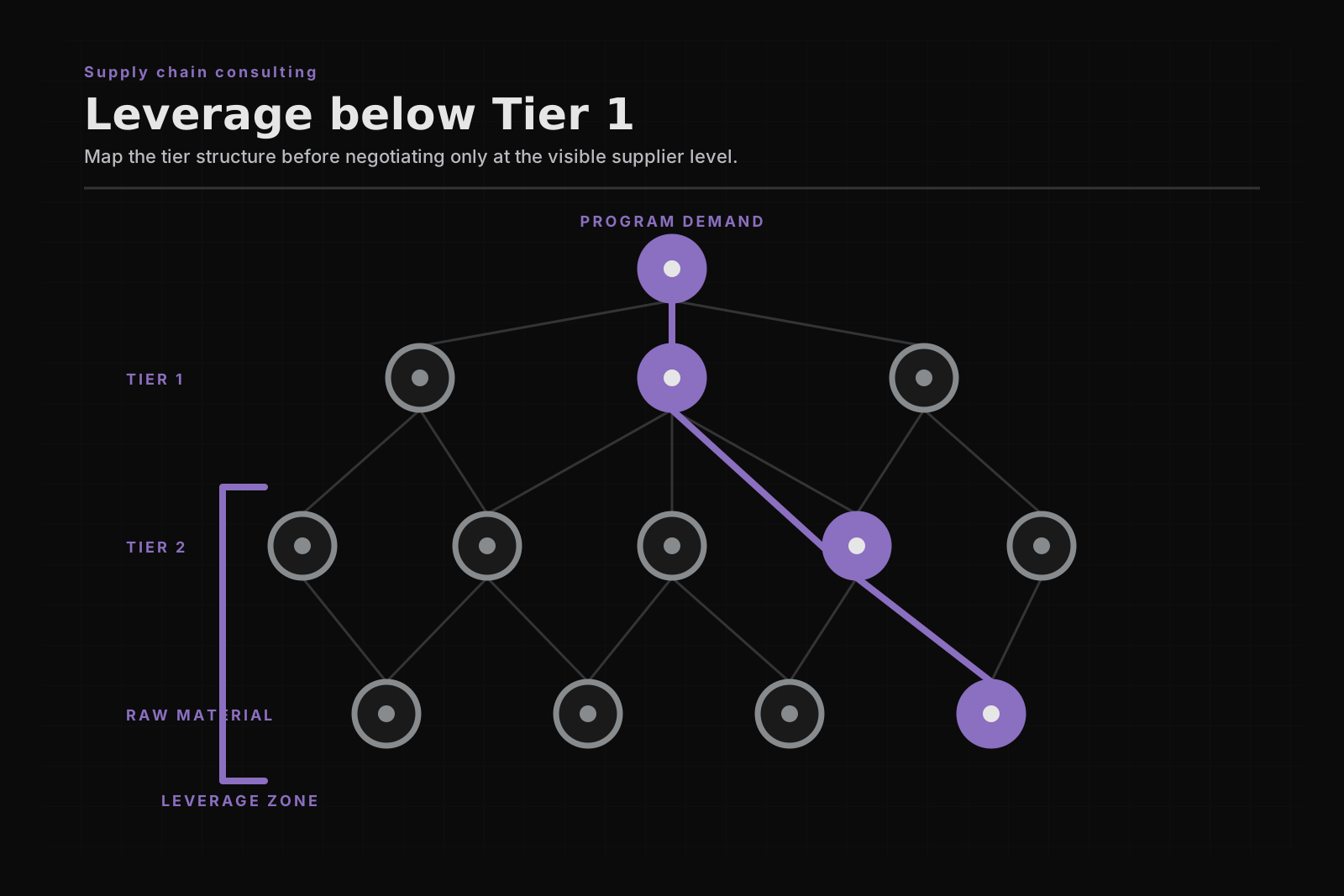
On qualified hardware the constraint frequently sits two or three tiers below the supplier the buyer talks to. Mill runs, heat lots, forging and casting slots, and specialty material availability set the schedule, and the buyer who only manages tier one is managing the symptom. The same is true of cost: material is often the largest single layer in the price, and it is bought by a supplier who has no volume leverage and no reason to hold a position.
Multi-tier raw material strategy means going to the source of the material, negotiating position and pricing there, and then flowing that position to the fabricators through directed buys, consignment, or free-issue arrangements. Significant cost reduction and schedule protection have come out of exactly this, by aggregating demand that was previously fragmented across suppliers and buying at the tier where the leverage actually exists.
The engagement covers demand aggregation across programs and business units, the qualification and traceability requirements that constrain how material can be positioned, the contractual mechanics of directed and free-issue material, and the liability questions that come with holding a material position.
Process improvement
Process improvement in this context means the procurement and material processes specifically, because that is where the recoverable time and money sit in a hardware organization. The recurring targets are the same across most engagements: the requisition-to-purchase-order cycle and the approval routing inside it, the accuracy of the planning system’s parameters, the discipline of the make-or-buy decision, the content and revision control of purchase orders, the receiving and source inspection path, and the handling of nonconforming material through disposition.
The method is straightforward and deliberately unglamorous. Establish the baseline from the system’s own transaction data rather than from what the team believes the cycle time is. Map the process as it is actually performed, including the workarounds, which are usually where the real process lives. Identify the steps that exist because of a compliance requirement, the steps that exist because of a system limitation, and the steps that exist because someone was once burned, since those three categories get fixed in completely different ways. Rewrite the procedure, train the people who execute it, and instrument the result so the improvement is visible after the engagement ends.
Where the organization runs SAP, Costpoint, Unanet, Deltek, or IFS, the work includes the system configuration and data hygiene that determine whether the process improvement survives contact with the ERP. A rewritten procedure that fights the system will be abandoned within two quarters.
The regulated part
Everything above happens inside a compliance envelope, and an approach that ignores it produces improvements that fail an audit. Engagements account for quality management system obligations under AS9100 and the first article inspection requirements that attach to them, special process control and the accreditation regime behind it, digital product definition and model-based requirements where the drawing is no longer the authority, and configuration and revision control across the supplier base.
Counterfeit part risk carries specific contractual obligations for electronic parts, including detection and avoidance system requirements and traceability to authorized sources, and those obligations flow down whether or not the buying organization has built a system to meet them. Obsolescence and diminishing sources management drives last-time buys that have to be forecast, funded, and stored, which is a cash and inventory decision as much as an engineering one. Export control obligations under ITAR and the EAR constrain which suppliers can be used, which drawings can be sent, and which nationals can touch the work.
Purchasing process work also has a direct compliance consequence: the same procedures, files, and price justification records that make a purchasing organization efficient are the ones a Contractor Purchasing System Review (CPSR) examines. Building the process correctly and building it to survive a CPSR are largely the same project, which is covered on the contract management page.
Results
At its largest scale the method has been run across a supplier base of hundreds of companies supporting the Orion and Artemis programs, which moved from commodity-based fulfillment to negotiated long-term agreements, and the purchasing system behind that supplier base passed federal review.
Start with the last twelve months of data
The most useful first conversation happens with real data in front of it: twelve months of purchase order history, delivery performance, and nonconformance records. That is usually enough to say where the recoverable time and cost actually sit, and whether an engagement is warranted at all.