
Contract and supply chain diligence for aerospace and defense transactions
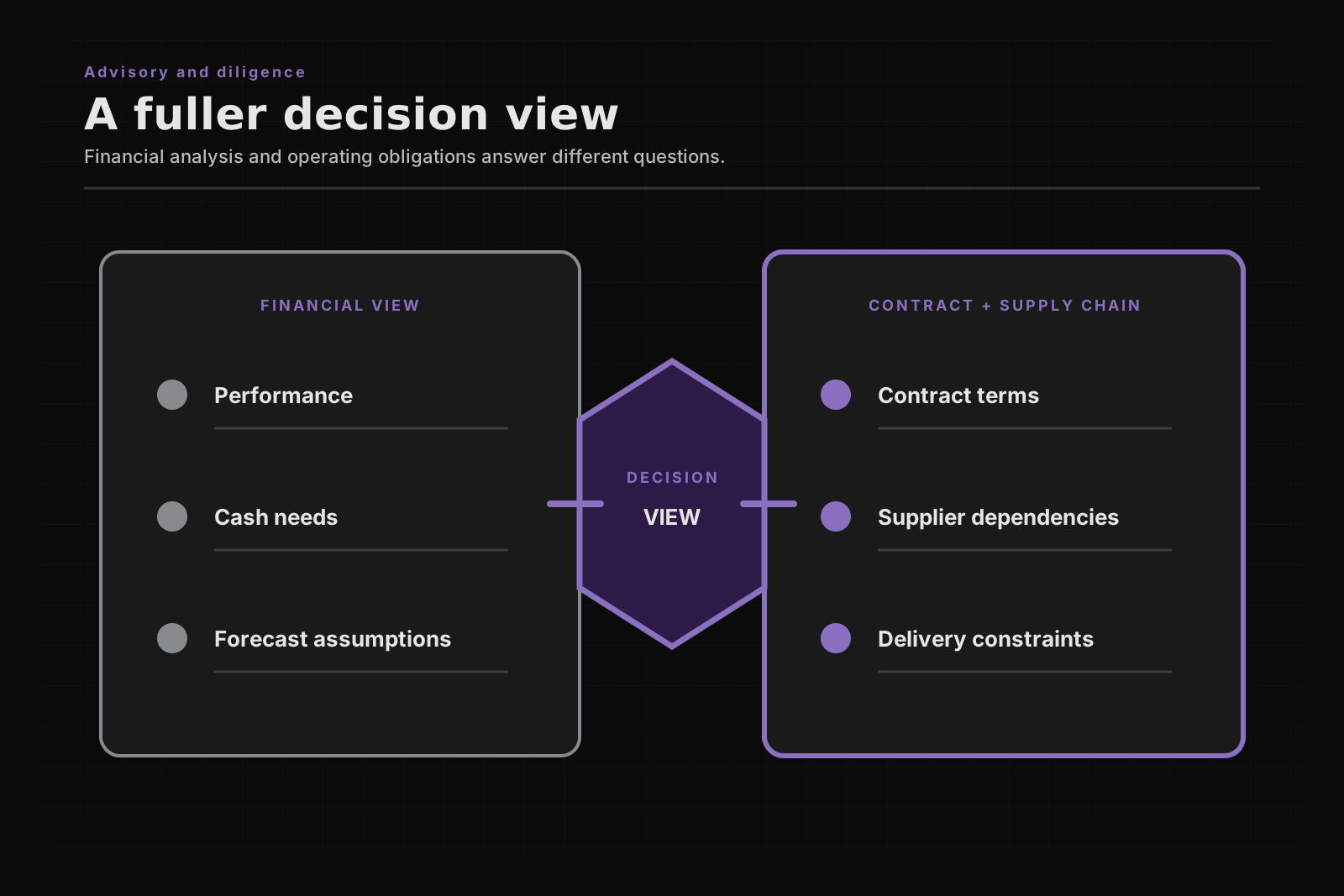
Financial diligence will tell a buyer what a company earned. It will not tell them that a third of the backlog sits under options the government is not obligated to exercise, that the purchasing system has never been reviewed, that the cyber flowdowns were accepted but never implemented, or that the single-source supplier for the primary structure has a two-year queue and no long-term agreement.
Sivad Enterprises reads a contract portfolio and a supply chain the way the counterparty will read them: sell-side to get a company ready to be examined, buy-side to find what the model does not show, and after close to make the combined supply base function as one organization.
Three lines of work

Market and regulatory read
A written assessment of where a company sits against demand, competition, and the compliance obligations that are about to become expensive.

Transaction diligence
Sell-side readiness and buy-side contract and supply chain risk analysis, delivered as a findings memorandum a deal team can act on.

Post-close integration
Bringing two supply bases, two sets of terms, and two purchasing organizations into one, and keeping the people who know how it works.
Market and regulatory read
An aerospace and defense company’s addressable market is defined as much by what it is allowed to do as by what it can build. A regulatory read establishes where the company actually stands, not where its policy manual says it stands.
What the assessment covers
- Contract vehicle position: where the company can be awarded work today, where it needs a vehicle it does not have, and what an Other Transaction Agreement changes about its access
- Contract type exposure across the portfolio and what the mix does to margin under stress
- Purchasing system status and whether a Contractor Purchasing System Review is foreseeable
- Cybersecurity obligations: what has been flowed down, what has been asserted, and the distance between the two
- Supply chain prohibition and sourcing rules, including covered telecommunications restrictions, specialty metals requirements, and domestic preference obligations
- Export control posture for hardware, technical data, and foreign national access
- Intellectual property and technical data rights: what has been delivered with what rights, and what that does to a future product business
- Small business subcontracting obligations and actual performance against the plan
- Customer and program concentration, recompete timing, and funding profile by fiscal year
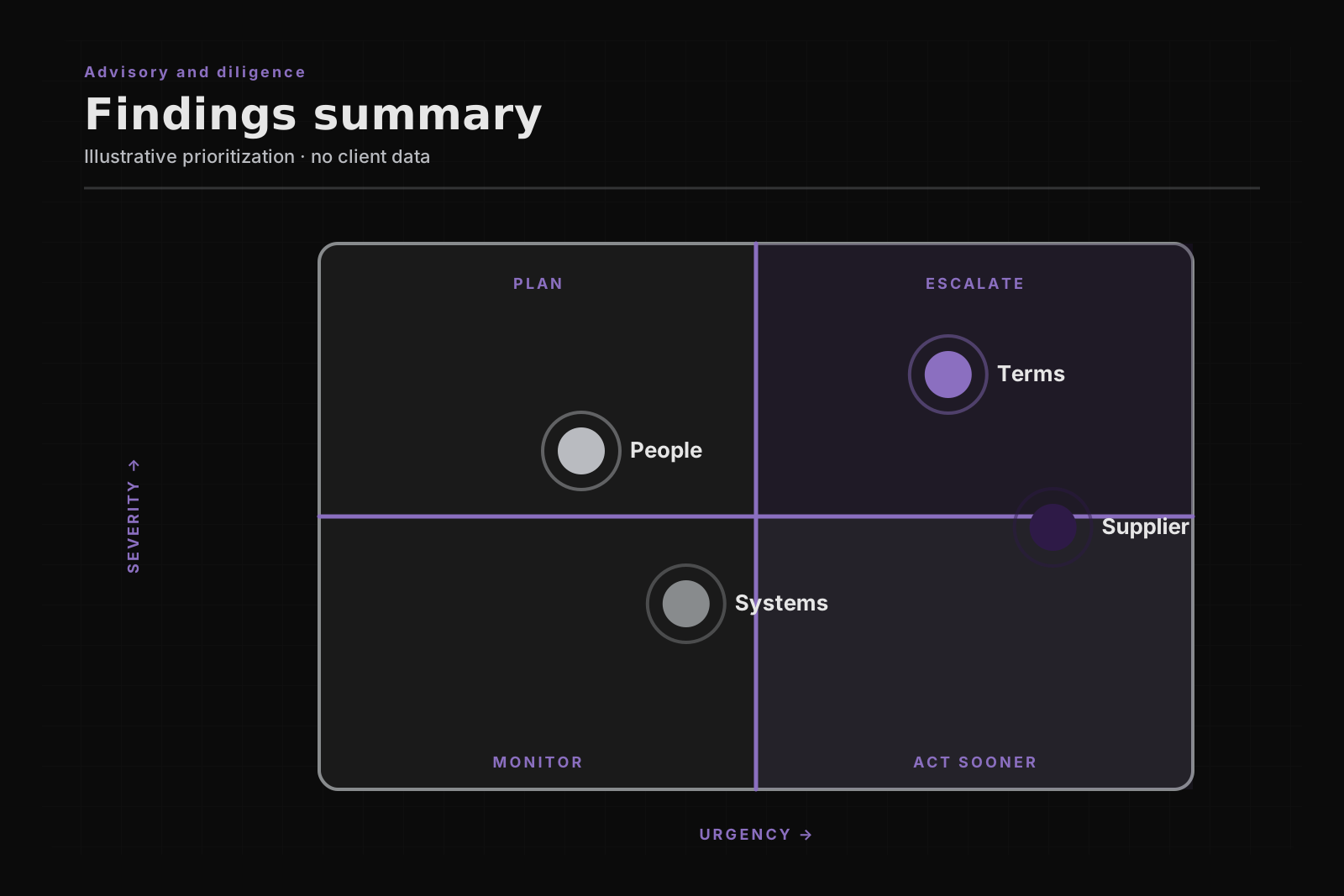
The deliverable is a written assessment with the findings ranked by cost and urgency, and a short list of what to fix first. It is written to be read by a board, which means it states what is wrong plainly rather than gesturing at areas of opportunity.
Transaction diligence
Sell-side readiness
A buyer’s counsel will ask for the contract files. What they find determines how much of the purchase price survives to closing. Sell-side work gets the record into a condition where the answers are ready before the questions arrive.
What we examine and put right
- Contract file completeness across the portfolio, including modifications, option exercises, and the funding history
- Backlog quality: funded against unfunded, priced options against unpriced, and how much of the stated backlog the government is actually obligated to buy
- Novation exposure and the realistic timeline for government consent under an asset structure, which is frequently the schedule driver nobody put in the plan
- Assignment, change of control, and anti-assignment provisions in both prime contracts and supplier agreements
- Certified cost or pricing data exposure and any defective pricing risk sitting in past awards
- Indirect rate structure, incurred cost submission status, and open audit items with the cognizant agency
- Purchasing system approval status and any outstanding corrective actions
- Organizational conflict of interest positions that constrain what the combined company may bid
- Technical data and software rights asserted, delivered, and marked, including anything delivered with unlimited rights that should not have been
- Supplier agreements that do not survive a change of control, and single-source positions with no alternate qualified
Buy-side contract and supply chain risk analysis
Buy-side work answers a narrower question: what is in this portfolio that will cost the acquirer money, time, or optionality after close, and how much. The output is a findings memorandum with each item quantified where it can be quantified, flagged as unquantifiable where it cannot, and written so it can be used in the negotiation rather than filed.
What the analysis produces
- A contract-by-contract risk read on the material agreements: type, ceiling, option structure, termination provisions, warranty tail, liquidated damages, indemnity, and limitation of liability
- Unpriced change orders and outstanding requests for equitable adjustment, with a view on which are collectible
- Flowdown gap analysis: obligations the target accepted from its customers against what it actually passed to its own suppliers, which is where post-close liability tends to sit
- Compliance state against cyber, sourcing, and domestic preference obligations, and the cost of closing the gap
- Supply base concentration, sole-source dependency, lead-time exposure on long-lead and flight-qualified items, and inventory position against forecast
- Key personnel provisions and the retention risk attached to named individuals
- A view on whether the target's purchasing system will withstand review as part of a larger enterprise, which is a different and harder test than it faced standing alone
- Integration cost estimate, separated into what must happen before close and what can wait
Post-close supply chain integration
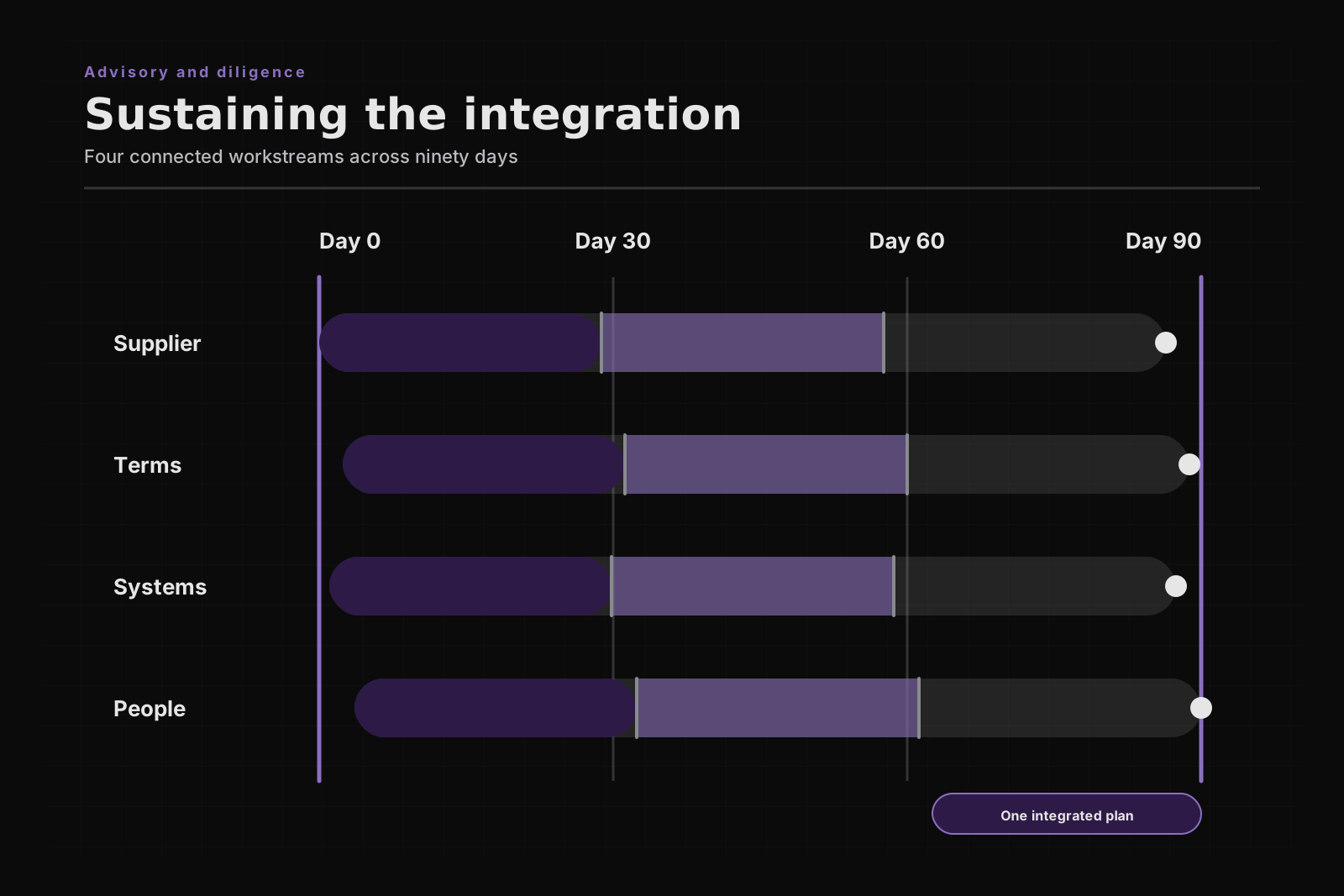
The first ninety days after close decide whether an acquisition delivers what the model promised. Two purchasing organizations are still buying under two sets of terms, two supplier lists overlap without anybody knowing by how much, two systems hold the data, and the buyers who understand the history are updating their resumes.
What integration work covers
- Supplier base mapping and overlap analysis, including where the two companies are buying the same commodity from the same supplier at different prices and different terms
- A single set of terms and conditions and a single flowdown matrix, with a transition plan for agreements that cannot simply be replaced
- Category strategy for the combined volume, and where combined demand actually creates leverage rather than theoretical leverage
- Purchasing system harmonization, including whether the combined entity's system faces review and what it must look like when it does
- System consolidation planning across the ERP and procurement stack, which in this industry usually means some combination of SAP, Costpoint, Deltek, Unanet, or IFS, and which is always slower than the plan assumes
- Make-or-buy review, dual-source qualification, and inventory rationalization
- Delegated authority, approval thresholds, and who is allowed to sign what on day one
Transition and change management
Integration fails on people more often than on process. The work here is unglamorous and specific: a stakeholder map that identifies who actually controls each supplier relationship, a communication sequence that reaches suppliers before rumor does, retention attention on the buyers and negotiators who hold the institutional knowledge, and a governance cadence with named owners and a metric each.
Where the combined organization needs a capability neither company had, training is built into the transition plan rather than bolted on afterwards. Sivad can design and deliver that directly, which shortens the distance between finding the gap and closing it.
Sustaining it
An integration is finished when the new way of working survives the departure of the person who introduced it. That means the terms are in the templates, the approval thresholds are in the system, the category strategies have owners, and the metrics are reviewed on a schedule that continues after the consultants leave. We build the handover into the engagement rather than treating it as a courtesy at the end.
How an engagement runs

| Phase | What happens | What sets its length |
|---|---|---|
| Scoping | Deal shape, data room access, what the deal team already knows, what decision the work has to support | Set by the deal timetable |
| Examination | Contract files, supplier agreements, compliance record, interviews with the people who run the function | — |
| Findings | Written memorandum, findings ranked and quantified where possible, working session with the deal team | Set by the deal timetable |
| Support | Availability through negotiation and, where engaged, into the integration plan | As required |
Diligence work is scoped as a fixed engagement against a defined portfolio, and integration is scoped in phases, because the second ninety days cannot be scoped accurately before the first ninety are underway.
Where the method was proven
Sivad Enterprises has operated for 13 years and is family-operated. The diligence practice is built on operating experience rather than on transaction volume, which is a deliberate distinction: the consultants who read these portfolios have run the functions being examined.
An acquired supply chain organization has been integrated into a major prime contractor after a transaction — procurement, planning, subcontracts, and property management — and the remediation plan that carried the resulting purchasing system through review was executed as part of that same work. A commercial space company has been carried through diligence and sale on an analysis of its contract portfolio and the risk sitting inside it. And supply chain organizations have been run across supplier bases of hundreds of companies, with contract portfolios at major-program scale, spanning two decades of programs across NASA, the Department of Defense, and the defense and space industrial base.
Before the letter of intent, not after
The cheapest time to find a contract or supply chain problem is while there is still price to negotiate against it. If a transaction is in motion, the first conversation should happen now.