
Executive leadership for aerospace and defense teams
This industry promotes on technical strength, which is reasonable, and then provides very little support for the transition that follows. A buyer who was excellent at buying becomes a manager of buyers. A contracts specialist who knew the clause set becomes responsible for a function, a budget, and an audit result. A capture lead who could win becomes accountable for a team’s pipeline. In each case the skill that earned the promotion is not the skill the new role requires, and the gap tends to be discovered in the middle of something consequential.
Sivad’s consultants work on that transition and on the structural questions behind it: who is ready, who is not, what happens when a critical person leaves, and whether the organization’s capability is genuinely institutional or is sitting in three people’s heads and their relationships.

Coaching
Coaching runs one to one against objectives the leader and their sponsor both agree to at the start, scoped to the situation rather than to a calendar, and the consultant carrying it is matched to the situation rather than assigned by whoever is free. The work is specific to the person’s actual situation rather than to a general model of leadership, and the measure of success is what changes in how they decide, communicate, and build their team.

Decision quality and strategy
The most common gap in a newly promoted technical leader is not analytical ability. It is prioritization under conditions where every option is defensible and the cost of doing all of them is that none of them finish. Coaching here works on how decisions get made and how they get sequenced: reading the data the organization already has rather than commissioning more of it, distinguishing the decisions that are reversible from the ones that are not, and building a plan that survives the first change in program funding.
- Prioritizing a portfolio of work against limited capacity
- Using the organization's existing data rather than waiting for better data
- Building plans with a stated horizon and stated assumptions
- Recognizing which decisions to make quickly and which to hold

Executive credibility
Senior technical leaders are frequently more capable than they appear in the rooms that matter, because the way they present in a program review is not the way an executive committee or a customer’s leadership consumes information. This track works on being clear and credible under pressure: leading with the answer, defending a position without becoming defensive, disagreeing with a superior in a way that is heard, and delivering bad news early enough that it can still be acted on.
- Structuring a briefing so the conclusion arrives first
- Holding a position under challenge without escalation
- Communicating risk and schedule slip honestly and early
- Presenting to boards, customers, and government stakeholders

Growing into a larger role
The third track is about scope. A leader who was effective over one team is now accountable across several, or across functions they have never performed, and the instinct to keep doing the work personally is the thing most likely to stall them. Coaching addresses delegation that is real rather than nominal, developing the people underneath rather than routing around them, adapting as the role changes, and building the judgment to know which problems genuinely require the leader’s attention.
- Delegating with authority attached, not just tasks
- Leading functions the leader has not personally performed
- Developing successors rather than dependents
- Adjusting as scope, headcount, or the operating model changes
Succession planning
Key-person risk in this industry is usually worse than the organization believes, and it is rarely where the organization is looking. It is not only the executive whose departure would be noticed. It is the one buyer who understands how a sole-source supplier’s pricing actually works, the contracts manager who is the only person who has been through a Contractor Purchasing System Review (CPSR), the capture lead whose relationship with a customer’s program office is the reason the recompete is winnable. None of that is documented anywhere, and in a market where an individual can be hired away by a company offering a better title or a shorter commute, it is a live exposure.
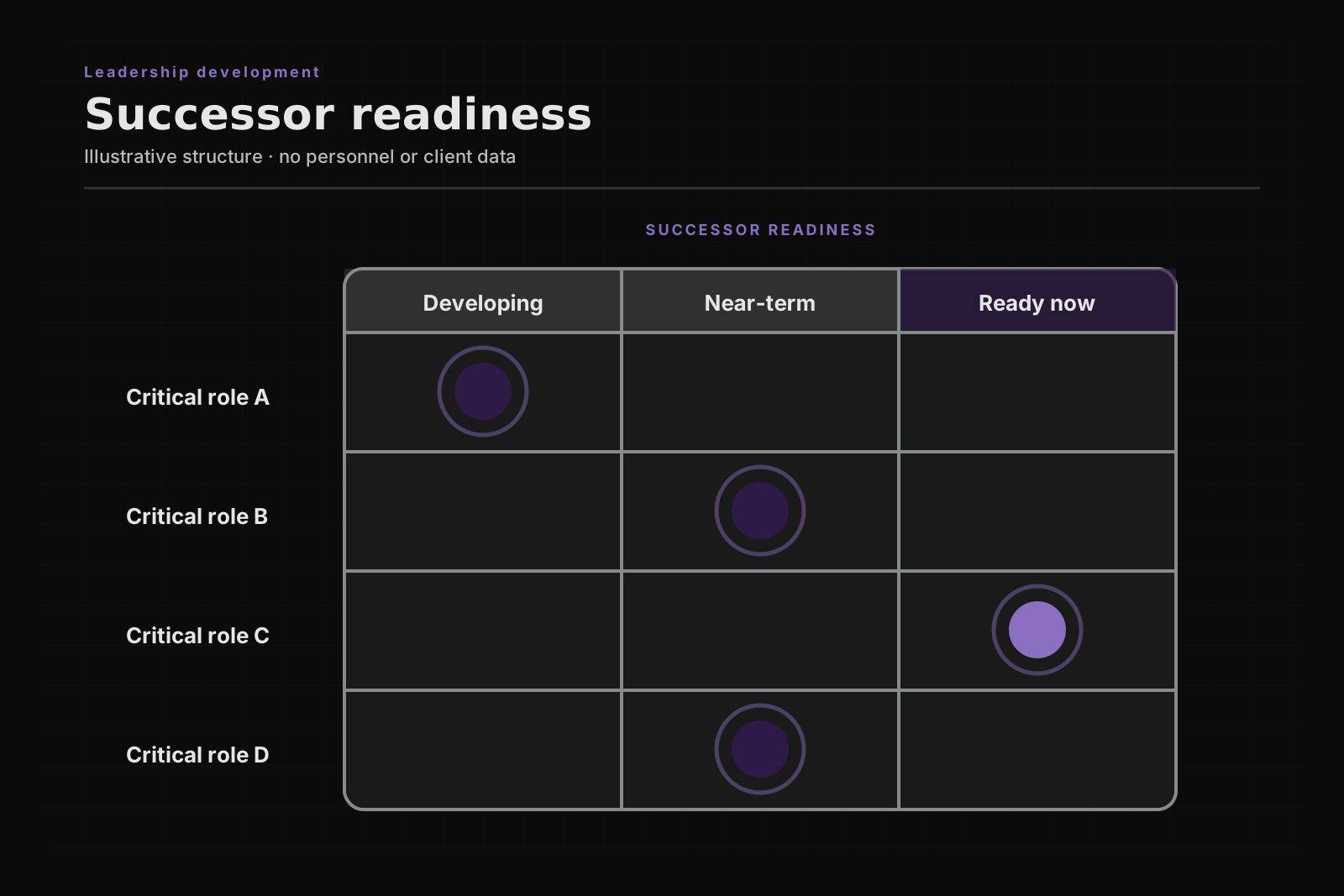
The work is methodical. Identify the roles that are genuinely critical, which is a different list from the roles that are senior. Assess who could cover each of them today, who could cover them within a year with development, and where there is simply no one. Build development plans against the gaps with dates and owners attached, and put in place the transfer of the things that are hardest to transfer: supplier and customer relationships, undocumented process knowledge, and the history behind decisions that look arbitrary without it.
The output is a bench map the executive team can act on, a set of individual development plans, and an honest statement of where the organization is exposed and what it would cost to close each gap. Some gaps get closed by development, some by hiring, and some by deciding to carry the risk with the exposure written down rather than assumed away.
Team capability
Individual coaching does not fix a function whose capability is unevenly distributed, and most supply chain, contracts, and business development teams in this market are uneven in predictable ways. Everyone can process a purchase order and very few can perform a cost analysis. Everyone knows the standard agreement and one person knows what to do when the customer redlines it. The team’s real capacity is set by the number of people who can handle the hard cases, not by headcount.
Capability work starts by mapping the skills the function actually needs against the contract types, supplier categories, systems, and customers it actually serves, and then assessing the team honestly against that map. What follows is usually a mix: targeted training where the gap is knowledge, restructuring where the gap is how work is distributed, hiring where the gap cannot be trained in the time available, and a decision about which capabilities the organization will deliberately not build in-house.
Retention belongs in the same conversation, because a function that is developing people well is also a function people stay in. In a market competing for experienced staff, the practical retention levers are usually career path clarity, real development, and managers who are competent, which is where this work and the coaching work meet.
- Function capability map against contract types, suppliers, systems, and customers
- Team assessment against the map, by individual and in aggregate
- Training plan for the gaps that are trainable
- Structural recommendations on how work is distributed
- Hiring profile and sequence for the gaps that are not
Where the method was proven
The approach on this page was developed in practice rather than in a classroom. Inside a defense technology business unit, revenue grew substantially over a short run of years while annual gross margin widened, the team grew with it, and annual attrition stayed well below what this industry treats as normal — and growing a technical workforce that fast without losing people is a talent and leadership result before it is a financial one, because the margin improvement came from work that required capable managers and the retention is what made the growth compound rather than reset.
It is stated here because it is the clearest available evidence that this material has been applied at scale, under real conditions, with real consequences attached.
Start with the bench, not the individual
The most useful first conversation is usually about the whole function rather than one person: which roles are critical, who could cover them tomorrow, and where the organization would be exposed by a single resignation. Individual coaching engagements often follow from that conversation, and they work better when they do.