
Training built on your contracts, your suppliers, and your clause set
Most training bought in this industry is a generic course with an aerospace slide added to the front. It teaches a framework, the room agrees the framework is sensible, and nothing about Monday changes. Sivad Enterprises builds programs the other way around: we start from the work your team is actually failing at, build the modules from your own contracts, purchase files, and supplier agreements, and then measure whether the behavior moved.
Programs are built for supply chain, contract, and sales professionals in aerospace and defense. Sivad’s consultants design them, deliver them, and can host them so the material stays available after the room empties.
Who this is for

Supply chain and procurement teams
Buyers and subcontract administrators who can run a purchase order but cannot build a should-cost, defend price reasonableness in a purchase file, or hold a position against a sole-source supplier. Modules cover supplier segmentation, should-cost and price analysis, long-lead strategy, flowdown discipline, and the documentation a purchasing system review will actually ask for.

Contracts and compliance teams
Contract professionals who need to work fluently across FAR Part 12 and FAR Part 15, handle certified cost or pricing data, manage DFARS flowdowns without over-flowing them, and control change activity before it becomes a request for equitable adjustment. Modules cover contract type selection and its consequences, option structure, terminations, unpriced change orders, and how DCMA and DCAA behave.

Sales, capture, and business development
Sellers who are good in the room and weak on the paper. Modules cover price-to-win discipline, discount governance and who is allowed to approve what, structuring commercial pricing so terms can move without a contract action, and how a government or prime buyer evaluates a proposal once it leaves your hands.
How a program gets built

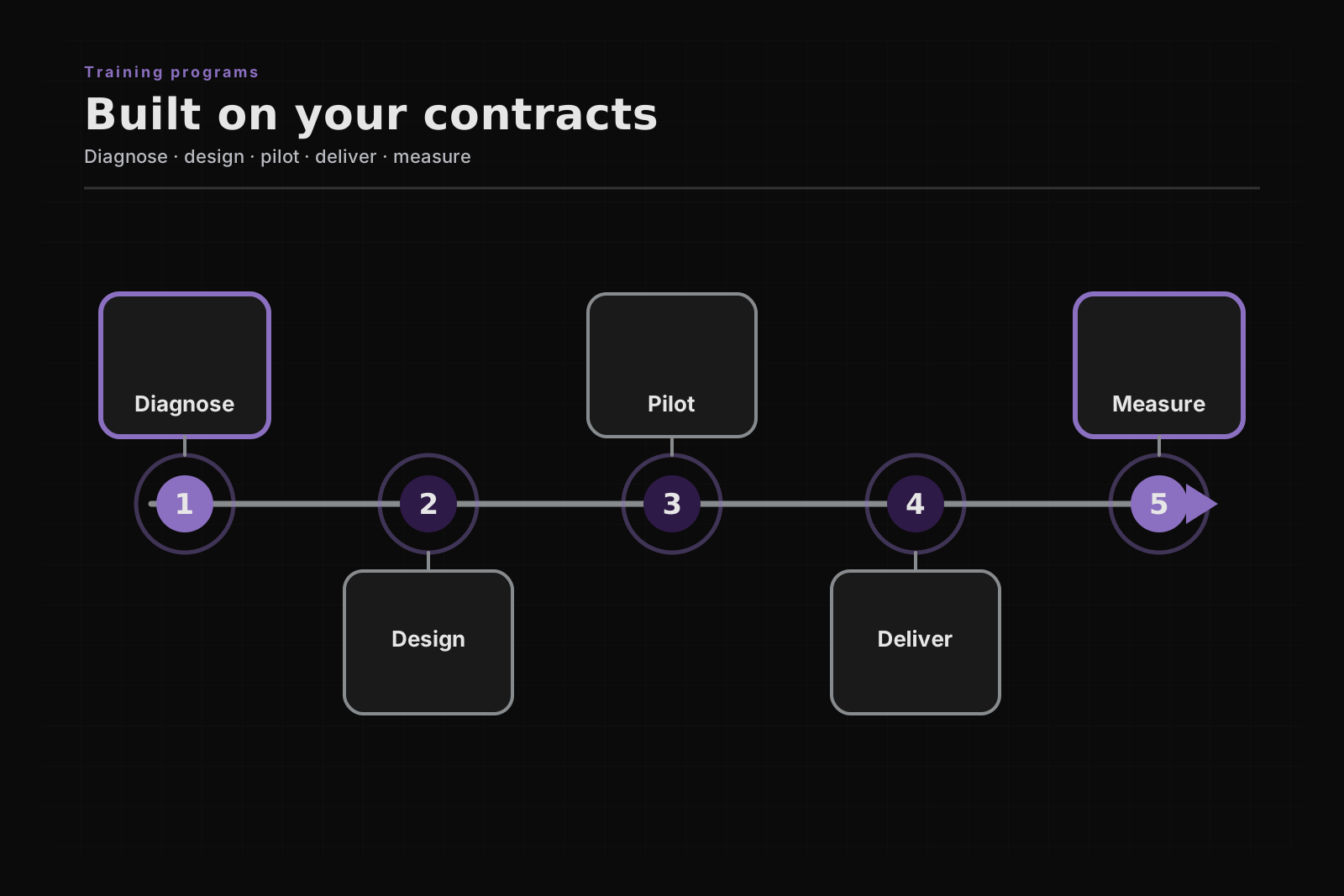
1. Diagnose
We start with the artifacts, not with interviews about the artifacts. That means a sample of purchase files, subcontracts, proposals, or negotiation memoranda, along with whatever metrics already exist: cycle time from requisition to award, on-time delivery, findings from the last audit, win rate, discount variance. Interviews come second and are used to test what the files already told us. The output is a written diagnosis of where the team is losing time, money, or defensibility, and it is deliberately specific enough to argue with.

2. Design
Modules are built against that diagnosis, using your documents as the working material. If your team negotiates against a prime that flows down the full DFARS cyber clause set, that is the exercise. If your problem is that buyers accept sole-source positions without testing them, the exercise is a real requisition from your own backlog. Every module states what a participant will be able to do at the end of it, in operational terms, and the design document goes to you for approval before anything is delivered.

3. Pilot
One cohort runs first, usually the team with the most immediate need rather than the most cooperative team. We watch where the material lands flat, where the exercises are too easy, and where the room stops talking. The design is revised before the program is rolled out further. Skipping the pilot is possible and occasionally correct on a short engagement, but it moves risk onto the full rollout.

4. Deliver
Delivery is a working session, not a lecture with a question period. Participants bring live work into the room and leave with a position, a file, a term sheet, or a plan they can use. Where a program runs over several weeks, participants carry an assignment from their own portfolio between sessions and the next session opens with what happened.

5. Measure
Measurement is agreed in the design phase, before delivery, so nobody is negotiating the definition of success after the fact. We measure reaction and confidence immediately, capability at the end of the program, and behavior in the operational data sixty to ninety days later. The measurement plan is written into the statement of work.
Delivery formats
| Format | What it is | Best for |
|---|---|---|
| On-site working session | Half day or full day, in your facility, using your documents | A single team with one urgent capability gap |
| Cohort program | Sessions with assignments between them, virtual or blended | Behavior change that has to survive contact with the day job |
| Hosted self-paced course | Modules, exercises, and assessments delivered on a hosted learning platform, opened to a defined roster | Distributed teams, onboarding, and refresher access after live delivery |
| Executive briefing | Ninety minutes for the leadership that has to sponsor and enforce the change | Making sure the program does not die when the cohort returns to their queue |
| Train the trainer | We build the curriculum and certify your internal facilitators to run it | Organizations that need the program to keep running without us |
Most engagements blend two of these. A common shape is an executive briefing, a live cohort, and then the same material hosted for reference and for people who join later.
Cohort size and what it changes
Cohort size is not a scheduling convenience. It determines whether every participant gets time in the chair, and negotiation and contract work do not improve without time in the chair. The table below is the design logic Sivad applies when scoping a program, not a report of results from past cohorts.
| Cohort size | What it makes possible |
|---|---|
| 6 to 10 | Every participant can run a live negotiation or build a real file with direct individual feedback. This is the band negotiation and subcontract work is designed for. |
| 11 to 20 | Paired and small-group exercises with rotating observation. Feedback is group-level rather than individual, which suits contract fundamentals and process modules. |
| 20 or more | Briefing and case discussion only. There is not enough time in the chair for skill building at this size, so it is scoped for awareness and shared vocabulary across a large organization and sequenced accordingly. |
Where a large population needs the same capability, the answer is several small cohorts run in sequence, supported by hosted material, rather than one large room.
How outcomes are measured
Measurement is agreed before delivery and reported in writing afterwards. Post-session and follow-up instruments run through Zoho Survey, and results are reported alongside the operational data rather than instead of it.
Level 1 — Reaction, captured the same day
A short instrument at the end of each session covering relevance, pace, and whether the participant expects to use the material. Useful for correcting delivery mid-program. Not evidence of anything else, and we will not present it as though it were.
Level 2 — Capability, at the end of the program
Assessed against the operational objectives written into the design document. For a negotiation program that means a scored live negotiation. For a purchasing module it means a purchase file built to standard and reviewed against the same checklist an auditor would use.
Level 3 — Behavior, sixty to ninety days out
A follow-up instrument to participants and their managers asking what has changed in the work, paired with whatever operational data the diagnosis identified. Cycle time from requisition to award. Number of files that survive internal review without rework. Discount variance against the approved schedule. The metrics are chosen in the design phase precisely so this measurement is possible.
Level 4 — Business result, where the data supports it
Some engagements can be tied to a business number and some cannot, and claiming otherwise is how training vendors lose credibility. Where the client already tracks a metric the program was designed to move, we report the movement and we state plainly what else was happening at the same time.

Where the method was proven
Sivad Enterprises has operated for 13 years and is family-operated. The curriculum is not adapted from a general business school syllabus. It comes out of running supply chain and contract organizations inside aerospace and defense: supplier bases of hundreds of companies, contract portfolios at major-program scale, and two decades of programs across NASA, the Department of Defense, and the defense and space industrial base.
It also comes out of carrying operating responsibility for a defense technology business unit, where revenue grew substantially, gross margin widened, and the team grew with it while annual attrition stayed well below the industry norm — included here because a training practice that has only ever taught, and never carried the number, teaches differently.
How an engagement starts
Engagements begin with a scoping conversation, move to a written design document with a defined scope, and are executed under an engagement letter, so that a client can approve the design before committing to a rollout.
Start with the diagnosis
The first conversation is about what your team cannot currently do and what it costs you. If a training program is not the right answer, we will say so.